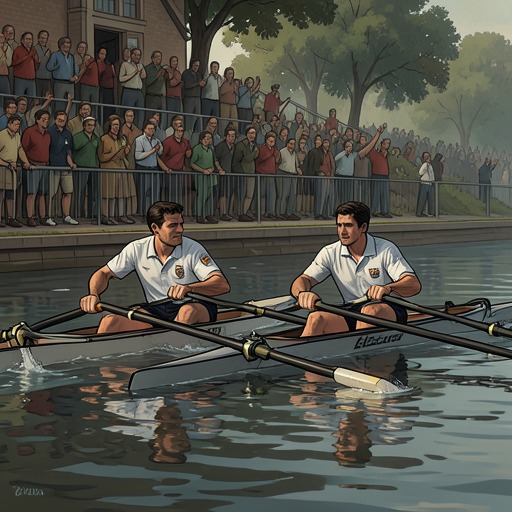
1932 Summer Olympics
The Boys in the BoatThe 1932 Summer Olympics marked a turning point in the western rowing rivalry between the University of Washington and the University of California, Berkeley: California’s crew won Olympic gold, while Washington failed to reach the Games after elimination in the trials. For Al Ulbrickson, the contrast made the defeat more than a single lost race; it became the low point against which his Washington crews’ later recovery would be measured.
A National Stage for Collegiate Rowing
In the 1920s and 1930s, collegiate crew drew crowds and press attention on a scale comparable to baseball and college football. National sportswriters covered major regattas, and devoted fans followed crews through training and racing seasons. The sport’s prestige, however, was concentrated in the East, where elite private schools modeled their rowing traditions on British institutions and sent oarsmen on to universities such as Harvard, Yale, and Princeton.
Western programs had to establish themselves in a sport whose center of influence lay elsewhere. The University of Washington and the University of California, Berkeley, had developed a rivalry dating to 1903, and their annual April races could attract tens of thousands of students, alumni, and local spectators. Yet both programs struggled for funding and recognition, had little access to wealthy patrons, and competed mostly against each other. California’s Olympic success gave the western contest a national dimension while underscoring how much prestige and opportunity were at stake.
Washington’s Route to the Trials
The 1932 Olympic setback came after a difficult season. At the annual Washington–California race on Lake Washington, more than one hundred thousand spectators watched in rough conditions. Wind raised whitecaps, and Washington’s shell took on water. By halfway, the oarsmen were rowing with several inches of water sloshing around their sliding seats; near the finish, the boat trailed California by eighteen lengths. It remained afloat, but the loss was the worst in Washington’s history.
Washington then sought redemption at the Intercollegiate Rowing Association regatta in Poughkeepsie, New York. California beat the varsity by five lengths. At the Olympic trials on Lake Quinsigamond in Massachusetts, Washington was eliminated in a preliminary contest. The sequence—from a disastrous home-water defeat to another loss at Poughkeepsie and then an early exit at the trials—left Ulbrickson’s crew without a place at the Games.
California’s Olympic Victory
In August, in Los Angeles, California coach Ky Ebright won the sport’s most coveted award: Olympic gold. The 1932 Olympic gold-medal crew became an important point of reference for the program; by the following winter, only one member of that crew still rowed for California. The result also gave Ebright a distinction his rival Ulbrickson had not achieved, intensifying an already consequential competition between the two coaches and their universities.
The contrast did not mean that California’s success resolved the broader imbalance between western and eastern rowing. Western schools still faced high travel costs when they ventured east, and their crews encountered condescension as well as curiosity. Olympic victory brought California national standing, but the western programs continued to compete in a system where eastern institutions held much of the established prestige and resources.
Defeat and Recovery
Washington regrouped quickly. In April 1933, a reconstituted varsity crew beat California on the Oakland Estuary, then defeated California and UCLA in Long Beach. After the Poughkeepsie regatta was canceled during the Depression, Washington returned to Long Beach to race Yale, Cornell, and Harvard; it edged Yale by eight feet and emerged as the de facto national champion. Ulbrickson later described that crew as the best he had assembled.
That recovery gives the 1932 Olympic campaign its particular place in the team’s story. The trials elimination and California’s gold exposed the distance Washington still had to travel, while the following season showed that the setback had not fixed the rivalry’s outcome. The Olympics supplied a public measure of success; Washington’s response came through the races that followed.